Sunday, March 24, 2013
Back To SharePoint
Hello everyone!
I am back into SharePoint business after a long break. You will start seeing my updates again in my blog (if time permits :))

Thursday, May 3, 2012
How to download and install Dashboard Designer in SP2010
The dasbhoard designer client tool of SP2010 can be installed manually by using the URL http://your server machine name/_layouts/PPSWebParts/DesignerRedirect.aspx
Thursday, March 4, 2010
Microsoft® Tech·Ed Middle East 2010 (MENA)
Oh..at last i got the opprotunity to attend the Tech-Ed 2010 MENA. The even was very successfull, being attended by professionals from across Midde East and Africa.
I have got the wonderful chance to meet Joel and Shahid Gaglani (once again). Joel as always done sessions with smiles and Shahid was not lined up for the session (unfortunately).
The other exciting figures of the event are Scott Hanselman and Micheal Noel!. Scott is excellent in his work, his session was awesome!...You are the man!.. You made the Asp.net MVC simpler to me.
Noel, you are the ocean of knowledge. You have the stuff to speak!
The very interested tracks were on MVC and SharePoint!
I have got the wonderful chance to meet Joel and Shahid Gaglani (once again). Joel as always done sessions with smiles and Shahid was not lined up for the session (unfortunately).
The other exciting figures of the event are Scott Hanselman and Micheal Noel!. Scott is excellent in his work, his session was awesome!...You are the man!.. You made the Asp.net MVC simpler to me.
Noel, you are the ocean of knowledge. You have the stuff to speak!
The very interested tracks were on MVC and SharePoint!
Saturday, August 15, 2009
HOW SHAREPOINT STORES DATA ?
One of the most important benefits of using SharePoint as an application platform is the ability to use its storagecontainers for storing application data, especially in the form of a list ‐ which is the fundamental data structure in SharePoint.
There are two kinds storage containers inside SharePoint: 1) Administration Store ‐ This store contains data relatedto site administration, containing information such as server farm and node setup, etc. ; and 2) Content Store ‐ Thisstore contains data related to site hierarchy as well as the content associated with the site, including user data ,layout, menu items, etc. The content database is where most application data will tend to reside. The use ofSharePoint storage containers is centered on the notion of list. A list is a collection of items or rows and can be usedto store application data.
There are two kinds storage containers inside SharePoint: 1) Administration Store ‐ This store contains data relatedto site administration, containing information such as server farm and node setup, etc. ; and 2) Content Store ‐ Thisstore contains data related to site hierarchy as well as the content associated with the site, including user data ,layout, menu items, etc. The content database is where most application data will tend to reside. The use ofSharePoint storage containers is centered on the notion of list. A list is a collection of items or rows and can be usedto store application data.
WHAT IS SITE PROVISIONING ?
Site provisioning in MOSS is the process of creating an instance of website/application using the pre-defined site definitions.
While creating an instance, the SP admin will choose a template that are registered in the server farm, (site definitions). In case, the site need to be modified after it has been provisioned,
Features allows change to an existing functionality associated with a provisioned site. Like SiteDefinition, Features is a collection of XML files that, once registered, becomes available to site administrators. A Feature applied at a SPSite scope is automaticallyavailable to all nested SPWebs
While creating an instance, the SP admin will choose a template that are registered in the server farm, (site definitions). In case, the site need to be modified after it has been provisioned,
Features allows change to an existing functionality associated with a provisioned site. Like SiteDefinition, Features is a collection of XML files that, once registered, becomes available to site administrators. A Feature applied at a SPSite scope is automaticallyavailable to all nested SPWebs
WHAT IS SITE DEFINITION IN MOSS ?
Any web application is ultimately a collection of static or dynamically generated web pages. WSS has two core entities, SPWeb and SPSite. An SPWeb entity is acollection of web pages and can be thought of as a sub‐site. A SPSite is a collection of SPWebs. Together SPWeb and SPSite allow the creation of custom web application topologies by defining what is knownas a site definition. It contains a number of SPWebs and how they are nested and other components such as
navigation, contents, custom code etc. Once the template or site definition has been defined and registered, SharePoint administrators can use them to provision sites.
navigation, contents, custom code etc. Once the template or site definition has been defined and registered, SharePoint administrators can use them to provision sites.
WHY MOSS AS AN APPLICATION DEVELOPMENT PLATFORM?
There are two major motivations for choosing MOSS/SharePoint as an application development platform:
- The need to provision more than one website based on a logical grouping ‐ such as department, regionor country ‐ rather than have one website that serves all users.
For example, a company needs to develop a web application for its partners that allow them access to pertinent sales information. The partners may want the sales information to surface differently (i.e. grouped byregions vs. grouped by cities), or they may want to co‐locate additional applications on the same page(i.e. a tax calculator). Rather than building all of this personalization in code, it is easier to provision asite for each partner that is based on a single common site blueprint. Each partner can then customizetheir site based on their specific needs via a single code base. - The need to manage un‐structured content (i.e. documents, web casts, etc.) along with the structureddata stored in a SQL database. A distinction between the structured content and unstructured content is that the former deals with data that can be viewed andmanaged using set‐based groupings (database views), whereas, the latter deals with data that ismanaged as explicit standalone entities along with the associated metadata. Not only is it important tomanage the integrity and security of standalone entities (such as documents); it is also important tomanage the relationships among them (for instance, the association relationship between a documentand structured application data).
Microsoft has introduced platforms/products such WSS and MOSS that build on ASP.NET technology to provide higher‐level building blocks such as the document library and lists, end‐user‐definedforms, search, personalization and workflow.
Wednesday, July 22, 2009
Public sites built on MOSS
Here is the another list of public sites built on MOSS platform
http://www.wssdemo.com/Shared%20Documents/Resources.aspx
http://www.wssdemo.com/Shared%20Documents/Resources.aspx
Tuesday, May 5, 2009
How to send document to record center programatically in MOSS 2007 ?
Here is the code to send document programatically in MOSS 2007. The below code can be used in console/win apps - but in the SharePoint box because of using SharePoint Object Libraries
private void SendDocumentToRecordsCenter()
{
try
{
string MoreInfo= string.Empty
OfficialFileResult Result;
SPSite mySite = new SPSite("http://ServerName");
SPWeb myWeb = mySite.OpenWeb();
SPFile myDoc = myWeb.GetFile("LibreryName/Doc1.docx");
Result =
myDoc.SendToOfficialFile(out MoreInfo);
Console.WriteLine("Result after execution: " + Result);
}
catch (Exception ex)
{
Console.WriteLine("Error - " + ex.ToString());
}
}
private void SendDocumentToRecordsCenter()
{
try
{
string MoreInfo= string.Empty
OfficialFileResult Result;
SPSite mySite = new SPSite("http://ServerName");
SPWeb myWeb = mySite.OpenWeb();
SPFile myDoc = myWeb.GetFile("LibreryName/Doc1.docx");
Result =
myDoc.SendToOfficialFile(out MoreInfo);
Console.WriteLine("Result after execution: " + Result);
}
catch (Exception ex)
{
Console.WriteLine("Error - " + ex.ToString());
}
}
Error in MOSS 2007 Record Center Site : "The Record Center is not properly configured for this request"
I have received the error message when i try to push a document from a MOSS site collection to the record center of the server farm.
"The Record Center is not properly configured for this request."
After a hell lot of investigations, i have found that the URL used for configuring the record center in the server farm was wrong.
It should be like
http://< Site DNS or Server Name >/<Record Center Site Name >/_vti_bin/officialfile.asmx
</ SharePointCoder>
"The Record Center is not properly configured for this request."
After a hell lot of investigations, i have found that the URL used for configuring the record center in the server farm was wrong.
It should be like
http://< Site DNS or Server Name >/<Record Center Site Name >/_vti_bin/officialfile.asmx
</ SharePointCoder>
Monday, May 4, 2009
Best practice for building SharePoint Solutions
For any SharePoint solution project, I stongly recommend prototyping before writing the complete code. We have been successfull with our prototyping approach. Prototyping helps us to get the user feedback and gives room for more successful delivery of the solution to meet the business requirement.
If we are not able to achieve some functionalities out of the box in SharePoint, we can go for customization using ASP.net code or third party components.
If we are not able to achieve some functionalities out of the box in SharePoint, we can go for customization using ASP.net code or third party components.
How to customize application master page in MOSS 2007
Here is a way how to use the site master page in application pages like settings.aspx in MOSS.
http://superbranding.codeplex.com/
http://superbranding.codeplex.com/
Master Pages and Page Layouts in MOSS 2007
This is worth reading SharePoint Developers...
Approaches to Creating Master Pages and Page Layouts in SharePoint Server 2007
Approaches to Creating Master Pages and Page Layouts in SharePoint Server 2007
Wednesday, April 29, 2009
Announcing Service Pack 2 for Office SharePoint Server 2007 and Windows SharePoint Services 3.0
Service Pack 2 for Office SharePoint Server 2007 and Windows SharePoint Services 3.0 has been released to the Microsoft Download Center. It includes all the fixes prior to SP2, and also several enhancements to improve server farm performance, availability and stability. Plus, a new stsadm operation has been added to help customers prepare for the upgrade to the next version of SharePoint.
Download Links
Service Pack 2 for Windows SharePoint Services 3.0, x86 & x64
http://www.microsoft.com/downloads/details.aspx?FamilyId=79BADA82-C13F-44C1-BDC1-D0447337051B&displaylang=en
Service Pack 2 for Office SharePoint Server 2007, x86 & x64
http://www.microsoft.com/downloads/details.aspx?FamilyId=B7816D90-5FC6-4347-89B0-A80DEB27A082&displaylang=en
Installation Steps
To keep all the files in a SharePoint installation up-to-date, the following packages need to be applied on all servers in the farm. Service Pack 2 contains all fixes released through February of this year, so customers can install it directly on RTM build of the products.
Service Pack 2 for Windows SharePoint Services 3.0
Service Pack 2 for Windows SharePoint Services 3.0 Language Pack (if applicable)
Service Pack 2 for Office SharePoint Server 2007
Service Pack 2 for Office SharePoint Server 2007 Language Pack (if applicable)
After applying the preceding updates, run the SharePoint Products and Technologies Configuration Wizard or "psconfig –cmd upgrade –inplace b2b -wait” in command line. This needs to be done on every server in the farm with SharePoint installed. The version of content databases should be 12.0.0.6421 after successfully applying these updates.
For more in-depth guidance for the update process, we recommend that customers refer to the following articles. These articles provide a correct way to deploy updates, identify known issues (and resolutions), and provide information about creating slipstream builds
Download Links
Service Pack 2 for Windows SharePoint Services 3.0, x86 & x64
http://www.microsoft.com/downloads/details.aspx?FamilyId=79BADA82-C13F-44C1-BDC1-D0447337051B&displaylang=en
Service Pack 2 for Office SharePoint Server 2007, x86 & x64
http://www.microsoft.com/downloads/details.aspx?FamilyId=B7816D90-5FC6-4347-89B0-A80DEB27A082&displaylang=en
Installation Steps
To keep all the files in a SharePoint installation up-to-date, the following packages need to be applied on all servers in the farm. Service Pack 2 contains all fixes released through February of this year, so customers can install it directly on RTM build of the products.
Service Pack 2 for Windows SharePoint Services 3.0
Service Pack 2 for Windows SharePoint Services 3.0 Language Pack (if applicable)
Service Pack 2 for Office SharePoint Server 2007
Service Pack 2 for Office SharePoint Server 2007 Language Pack (if applicable)
After applying the preceding updates, run the SharePoint Products and Technologies Configuration Wizard or "psconfig –cmd upgrade –inplace b2b -wait” in command line. This needs to be done on every server in the farm with SharePoint installed. The version of content databases should be 12.0.0.6421 after successfully applying these updates.
For more in-depth guidance for the update process, we recommend that customers refer to the following articles. These articles provide a correct way to deploy updates, identify known issues (and resolutions), and provide information about creating slipstream builds
Content types in MOSS 2007
Content types are one of the new features in Windows SharePoint Services 3.0. It is same as "Template Object" in Microsoft Content Management Server 2002 (MCMS 2002).
It allows you to store multiple types of data in the same list or document library by data encapsulation. It encapsulates the data scheme and makes it independent of SharePoint list or library.
For examples, you can store contracts of both building and vehicle in the same document library or list in SharePoint although the data schema are different for each one.
For building contract, the columns or data will be - Tenant Name, Building No, Contract Details, etc. and for vehicle contract - Tenant Name, Vehicle Registration No, Tenant License No, Contract Details, etc.
All the two type above documents will reside in the same list or library by defining two content types in WSS 3.0 / MOSS 2007.
It allows you to store multiple types of data in the same list or document library by data encapsulation. It encapsulates the data scheme and makes it independent of SharePoint list or library.
For examples, you can store contracts of both building and vehicle in the same document library or list in SharePoint although the data schema are different for each one.
For building contract, the columns or data will be - Tenant Name, Building No, Contract Details, etc. and for vehicle contract - Tenant Name, Vehicle Registration No, Tenant License No, Contract Details, etc.
All the two type above documents will reside in the same list or library by defining two content types in WSS 3.0 / MOSS 2007.
Sunday, April 26, 2009
SharePoint 2010 ......
The new version of SharePoint (SharePoint 14) called "SharePoint 2010" is on its way. It has been decided to change the name of the product. Hence there will be no more "MOSS".
Read more here
http://blogs.msdn.com/sharepoint/archive/2009/04/14/microsoft-sharepoint-14-is-now-microsoft-sharepoint-2010.aspx
http://www.microsoft.com/presspass/features/2009/Apr09/04-15Office2010.mspx
Read more here
http://blogs.msdn.com/sharepoint/archive/2009/04/14/microsoft-sharepoint-14-is-now-microsoft-sharepoint-2010.aspx
http://www.microsoft.com/presspass/features/2009/Apr09/04-15Office2010.mspx
How to query SharePoint list data using web service
There are scenarios where we need to extract or query data of SharePoint using some custom code - say in console or winform application.
Here is the sample code and procedure
Add the web reference for the web service in your .net project http:///_vti_bin/Lists.asmx with alias as MyLists
Now use the below code
MyLists.Lists listService = new MyLists.Lists();
listService.Credentials = System.Net.CredentialCache.DefaultNetworkCredentials;
//
listService.Url = "http:///_vti_bin/Lists.asmx";
// Instantiate an XmlDocument object
System.Xml.XmlDocument xmlDoc = new System.Xml.XmlDocument();
//
string listName = "Purchase Orders";
string viewName = "";//blank for default
//
/*Use the CreateElement method of the document object to create elements for the parameters that use XML.*/
XmlElement query = xmlDoc.CreateElement("Query");
XmlElement viewFields = xmlDoc.CreateElement("ViewFields");
XmlElement queryOptions = xmlDoc.CreateElement("QueryOptions");
//
//The below query applies filter "where Field1 = 1"
query.InnerXml = "
"1
//The below string specified which are the fields to be returned in the result
//apart from the default fields
viewFields.InnerXml = "
queryOptions.InnerXml = "FALSE TRUE
//
/* Declare an XmlNode object and initialize it with the XML response from the GetListItems method.
* The last parameter specifies the GUID of the Web site containing the list.
* Setting it to null causes the Web site specified by the Url property to be used.*/
System.Xml.XmlNode nodeListItems = listService.GetListItems(listName, viewName, query, viewFields, rowLimit, queryOptions);
//
DataSet ds = new DataSet();
XmlTextReader myReader = new XmlTextReader(new MemoryStream(ASCIIEncoding.Default.GetBytes(nodeListItems.OuterXml)));
ds.ReadXml(myReader);
Here is the sample code and procedure
Add the web reference for the web service in your .net project http://
Now use the below code
MyLists.Lists listService = new MyLists.Lists();
listService.Credentials = System.Net.CredentialCache.DefaultNetworkCredentials;
//
listService.Url = "http://
// Instantiate an XmlDocument object
System.Xml.XmlDocument xmlDoc = new System.Xml.XmlDocument();
//
string listName = "Purchase Orders";
string viewName = "";//blank for default
//
/*Use the CreateElement method of the document object to create elements for the parameters that use XML.*/
XmlElement query = xmlDoc.CreateElement("Query");
XmlElement viewFields = xmlDoc.CreateElement("ViewFields");
XmlElement queryOptions = xmlDoc.CreateElement("QueryOptions");
//
//The below query applies filter "where Field1 = 1"
query.InnerXml = "
"
//The below string specified which are the fields to be returned in the result
//apart from the default fields
viewFields.InnerXml = "
queryOptions.InnerXml = "
//
/* Declare an XmlNode object and initialize it with the XML response from the GetListItems method.
* The last parameter specifies the GUID of the Web site containing the list.
* Setting it to null causes the Web site specified by the Url property to be used.*/
System.Xml.XmlNode nodeListItems = listService.GetListItems(listName, viewName, query, viewFields, rowLimit, queryOptions);
//
DataSet ds = new DataSet();
XmlTextReader myReader = new XmlTextReader(new MemoryStream(ASCIIEncoding.Default.GetBytes(nodeListItems.OuterXml)));
ds.ReadXml(myReader);
Sunday, April 5, 2009
How to create minimal master page in moss 2007 ?
To create a minimal master page
- Open SharePoint Designer.
- On the File menu, click New, point to SharePoint Content, and then click the Page tab.
- Double-click Master Page to create a new master page.
- Click Design to show the master page in design view. You should see header and left margin areas and several content placeholders in the master page.
- Click Code to show the master page in code view.
- Copy the following code into the master page.
- On the File menu, click Save As, provide a unique file name with the .master extension, and then save the file to the master page gallery (/_catalogs/masterpage) in your site collection.
<%-- Identifies this page as a .master page written in Microsoft Visual C# and registers tag prefixes, namespaces, assemblies, and controls. --%>
<%@ Master language="C#" %>
<!DOCTYPE html PUBLIC "-//W3C//DTD HTML 4.01 Transitional//EN" "http://www.w3.org/TR/html4/loose.dtd">
<%@ Import Namespace="Microsoft.SharePoint" %>
<%@ Register Tagprefix="SPSWC" Namespace="Microsoft.SharePoint.Portal.WebControls" Assembly="Microsoft.SharePoint.Portal, Version=12.0.0.0, Culture=neutral, PublicKeyToken=71e9bce111e9429c" %>
<%@ Register Tagprefix="SharePoint" Namespace="Microsoft.SharePoint.WebControls" Assembly="Microsoft.SharePoint, Version=12.0.0.0, Culture=neutral, PublicKeyToken=71e9bce111e9429c" %>
<%@ Register Tagprefix="WebPartPages" Namespace="Microsoft.SharePoint.WebPartPages" Assembly="Microsoft.SharePoint, Version=12.0.0.0, Culture=neutral, PublicKeyToken=71e9bce111e9429c" %>
<%@ Register Tagprefix="PublishingWebControls" Namespace="Microsoft.SharePoint.Publishing.WebControls" Assembly="Microsoft.SharePoint.Publishing, Version=12.0.0.0, Culture=neutral, PublicKeyToken=71e9bce111e9429c" %>
<%@ Register Tagprefix="PublishingNavigation" Namespace="Microsoft.SharePoint.Publishing.Navigation" Assembly="Microsoft.SharePoint.Publishing, Version=12.0.0.0, Culture=neutral, PublicKeyToken=71e9bce111e9429c" %>
<%@ Register TagPrefix="wssuc" TagName="Welcome" src="~/_controltemplates/Welcome.ascx" %>
<%@ Register TagPrefix="wssuc" TagName="DesignModeConsole" src="~/_controltemplates/DesignModeConsole.ascx" %>
<%@ Register TagPrefix="PublishingVariations" TagName="VariationsLabelMenu" src="~/_controltemplates/VariationsLabelMenu.ascx" %>
<%@ Register Tagprefix="PublishingConsole" TagName="Console" src="~/_controltemplates/PublishingConsole.ascx" %>
<%@ Register TagPrefix="PublishingSiteAction" TagName="SiteActionMenu" src="~/_controltemplates/PublishingActionMenu.ascx" %>
<%-- Uses the Microsoft Office namespace and schema. --%>
<html>
<WebPartPages:SPWebPartManager runat="server"/>
<SharePoint:RobotsMetaTag runat="server"/>
<%-- The head section includes a content placeholder for the page title and links to CSS and ECMAScript (JScript, JavaScript) files that run on the server. --%>
<head runat="server">
<asp:ContentPlaceHolder runat="server" id="head">
<title>
<asp:ContentPlaceHolder id="PlaceHolderPageTitle" runat="server" />
</title>
</asp:ContentPlaceHolder>
<Sharepoint:CssLink runat="server"/>
<asp:ContentPlaceHolder id="PlaceHolderAdditionalPageHead" runat="server" />
</head>
<%-- When loading the body of the .master page, SharePoint Server 2007 also loads the SpBodyOnLoadWrapper class. This class handles .js calls for the master page. --%>
<body onload="javascript:_spBodyOnLoadWrapper();">
<%-- The SPWebPartManager manages all of the Web part controls, functionality, and events that occur on a Web page. --%>
<form runat="server" onsubmit="return _spFormOnSubmitWrapper();">
<wssuc:Welcome id="explitLogout" runat="server"/>
<PublishingSiteAction:SiteActionMenu runat="server"/>
<PublishingWebControls:AuthoringContainer id="authoringcontrols" runat="server">
<PublishingConsole:Console runat="server" />
</PublishingWebControls:AuthoringContainer>
<%-- The PlaceHolderMain content placeholder defines where to place the page content for all the content from the page layout. The page layout can overwrite any content placeholder from the master page. Example: The PlaceHolderLeftNavBar can overwrite the left navigation bar. --%>
<asp:ContentPlaceHolder id="PlaceHolderMain" runat="server" />
<asp:Panel visible="false" runat="server">
<%-- These ContentPlaceHolders ensure all default SharePoint Server pages render with this master page. If the system master page is set to any default master page, the only content placeholders required are those that are overridden by your page layouts. --%>
<asp:ContentPlaceHolder id="PlaceHolderSearchArea" runat="server"/>
<asp:ContentPlaceHolder id="PlaceHolderTitleBreadcrumb" runat="server"/>
<asp:ContentPlaceHolder id="PlaceHolderPageTitleInTitleArea" runat="server"/>
<asp:ContentPlaceHolder id="PlaceHolderLeftNavBar" runat="server"/>
<asp:ContentPlaceHolder ID="PlaceHolderPageImage" runat="server"/>
<asp:ContentPlaceHolder ID="PlaceHolderBodyLeftBorder" runat="server"/>
<asp:ContentPlaceHolder ID="PlaceHolderNavSpacer" runat="server"/>
<asp:ContentPlaceHolder ID="PlaceHolderTitleLeftBorder" runat="server"/>
<asp:ContentPlaceHolder ID="PlaceHolderTitleAreaSeparator" runat="server"/>
<asp:ContentPlaceHolder ID="PlaceHolderMiniConsole" runat="server"/>
<asp:ContentPlaceHolder id="PlaceHolderCalendarNavigator" runat ="server" />
<asp:ContentPlaceHolder id="PlaceHolderLeftActions" runat ="server"/>
<asp:ContentPlaceHolder id="PlaceHolderPageDescription" runat ="server"/>
<asp:ContentPlaceHolder id="PlaceHolderBodyAreaClass" runat ="server"/>
<asp:ContentPlaceHolder id="PlaceHolderTitleAreaClass" runat ="server"/>
<asp:ContentPlaceHolder id="PlaceHolderBodyRightMargin" runat="server" />
</asp:Panel>
</form>
</body>
</html>
Wednesday, January 14, 2009
How to find the list of sql server 2005 instances running in a server box
The list of running sql 2k5 running in a server box is made visible by making use of SQL Server Surface Area Configuration Tool.
Here is the screen shot!
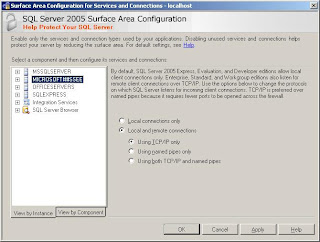
Here is the screen shot!
Subscribe to:
Posts (Atom)